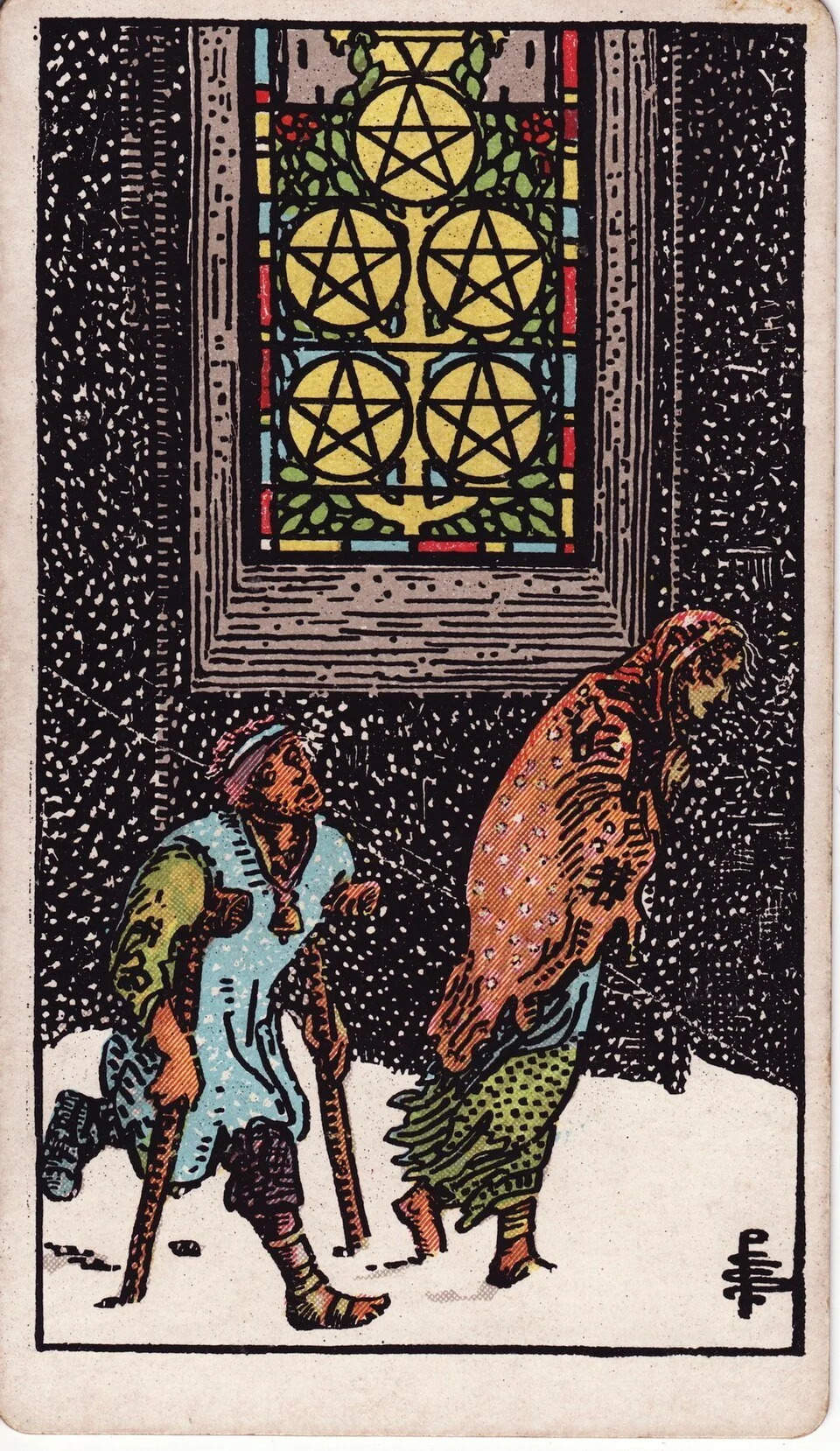
Five of Pentacles (coins)
finding reason to continue
Intro
Every decision we make is shaped by a clear sense of purpose. Our journey has been anything but ordinary. Through every step, we've focused on staying true to our values and making space for thoughtful, lasting work.
5 of Pentacles, Resources
*
5 of Pentacles, Resources *
-
BTW 47 : 5 of Pentacles — Real Gods Demand Blood
note #1
note #2
note #3
-
Episode
note #1
note #2
note #3
-
“Financial Loss, Poverty, Lack, Mindset, Isolation, Worry”
“You no longer feel safe because it has all been stripped away from you in one blow.”
“You may wonder, ‘Why is no-one coming to help me!?’ It may appear as if no one cares anymore.”
“People are here to support you. Find them and let them know you need them.”
“All you can see is what is going wrong. To shift this energy, look for evidence of what you do have, even if it’s very small or seemingly insignificant, and express your gratitude for those blessings in your life.”
Writing Prompts
Directions
skills we are honing :
stream-of-consciousness writing
ability to make associations
stop second guessing yourself
“perfection is the enemy of good”
I imagine at this point you have an idea what to expect. if you need a refresh on any of the directions, as you know, they still exist nestled into the previous week’s lesson.
how are you feeling? have you noticed any shifts in your work, or even your day-to-day life?
…why have i pushed these skills, week after week? not only will they help with these lessons, but they are skills that can be adapted to help you in all aspects of your life.
through developing our stream-of-consciousness writing skills, we’re building a stronger connection to our own inner world. it can also subconsciously help strengthen our focus by forcing us to stay engaged in the task we’re working on and not get distracted.
in exercising our ability to make associations we are utilizing our creative mind which can help us with problem solving IRL. by engaging in creative activities we allow our mind to play with new ways of thinking, which will inevitably bleed out into any form of problem solving: how to stack the dishes in the dishrack, how to organize a display for work, how to spend your sunday afternoon– it’s really amazing the subtle ways that practicing creativity can help us in seemingly unrelated and utilitarian ways.
the skill of trusting yourself (stop second guessing!) will be a lifelong adventure for some of us, but it helps us feel anchored into our sense of self and our values. trusting ourselves motivates us to take productive action, even when we are uncertain. it is a key skill for us to have as we move about the world– especially when there are so many predatory super-corporations who would love to profit off of you feeling listless or disconnected.
and not allowing perfectionism to get in our way of taking action is another important skill for us to have so that we put in the hours of trying imperfectly to learn anything. there is so much information that is so easily accessible to us; it can be tempting to become an armchair expert on something without realizing that true expertise comes from hours of repetitive action– not reading everything about a topic on the internet. it really is a humbling fact.
i had over a decade of plant experience before i worked with a youth farming non-profit, and even that didn’t save me from being just as awkward at bunching beets and carrots for market as any of the teens. and it wasn’t the experienced Farmer’s meticulous directions on how to do the task that helped me improve– but the weekly process of trying and failing to do it perfectly until the muscle memory was finally built up.
Developing Our Association Skills
Daily Gratitude
this simple practice doesn’t have to take up a lot of time, but contains immensely profound results.
in the morning, right after you wake up i want you to find the time to write down three things you genuinely feel grateful for. these don’t need to be earth-shattering events like climbing a mountain to see the sunrise, or spending time volunteering with a cause you feel passionately for. actually, it is more helpful to find gratitude in the immediate, the mundane, the day-to-day parts of your life.
if you’re a coffee drinker, maybe it’s that first cup you’re starting to brew that you’re grateful for— that warm, familiar smell brightening up the first hours of your day…
…or maybe it’s your beloved pet you spend every day with.
it can be the fact you have a day off. or you can be grateful for a silly app that helps you connect to your long-distant friends. it can be for the tree you see out the window every day, to have food in your fridge, or a family member who doesn’t live too far away—
don’t talk yourself out of being grateful for something, if it is truly something you feel. nothing is too small, too insignificant, too silly to be grateful for.
one of the most humbling experiences i had was listening to a dear friend who was going through some personally heartbreaking times. at one point she just stopped, and started listing off things she was grateful for– one of which was a pair of new sneakers for the gym, which she needed. through her tears of grief for her personal situation she laughed at her statement, “I mean, do new sneakers really matter at a time like this?”
the fact is, yes. right now when things seem darkest, getting a new pair of sneakers so you can continue going to the gym with the foot support you need matters most right now. it’s these little, attainable flickers of light in the darkness that we need to tend to. these are the small gems that keep us fighting, even as the shadow seems all consuming.
EXERCISE : Start a Daily Gratitude Journal
each day for the next week, take 3-5 minutes to list 3 things you are grateful for.
gauge when in the day you have the most focus/clarity. if you have more energy/focus in the morning— do it then. if you are more of an evening person, try doing your Daily Gratitude then.
if you feel like you don’t have enough time to do this daily practice— still try. could you set your alarm 5 minutes early? do it on a post-if on your bathroom mirror as you brush your teeth? do it on the commuter rail on your way to work? remember it is only 3-5 minutes.
try to physically do this practice. it doesn’t mean sending yourself a short text of your 3 things or doing it in your notes app doesn’t count as much as pen & paper— it does. but if you’re zipping through a list in your mind doesn’t.
continue with the practice beyond the 7 day period if you want too! but please try to engage for at least one week.